🌱 Expert Consensus
This is not just a quick tips list. This is a botanical deep-dive designed to help you keep your Poinsettia alive for decades, not just weeks. Grab a coffee, this is a comprehensive guide.
Most indoor gardeners share a common, tragic memory: receiving a lush, vibrant red Poinsettia in mid-December, only to watch it transform into a skeletal stick figure by mid-January. It’s a cycle of consumption that the horticultural industry relies on. They want you to treat this magnificent shrub as a disposable bouquet.
We are going to break that cycle today.
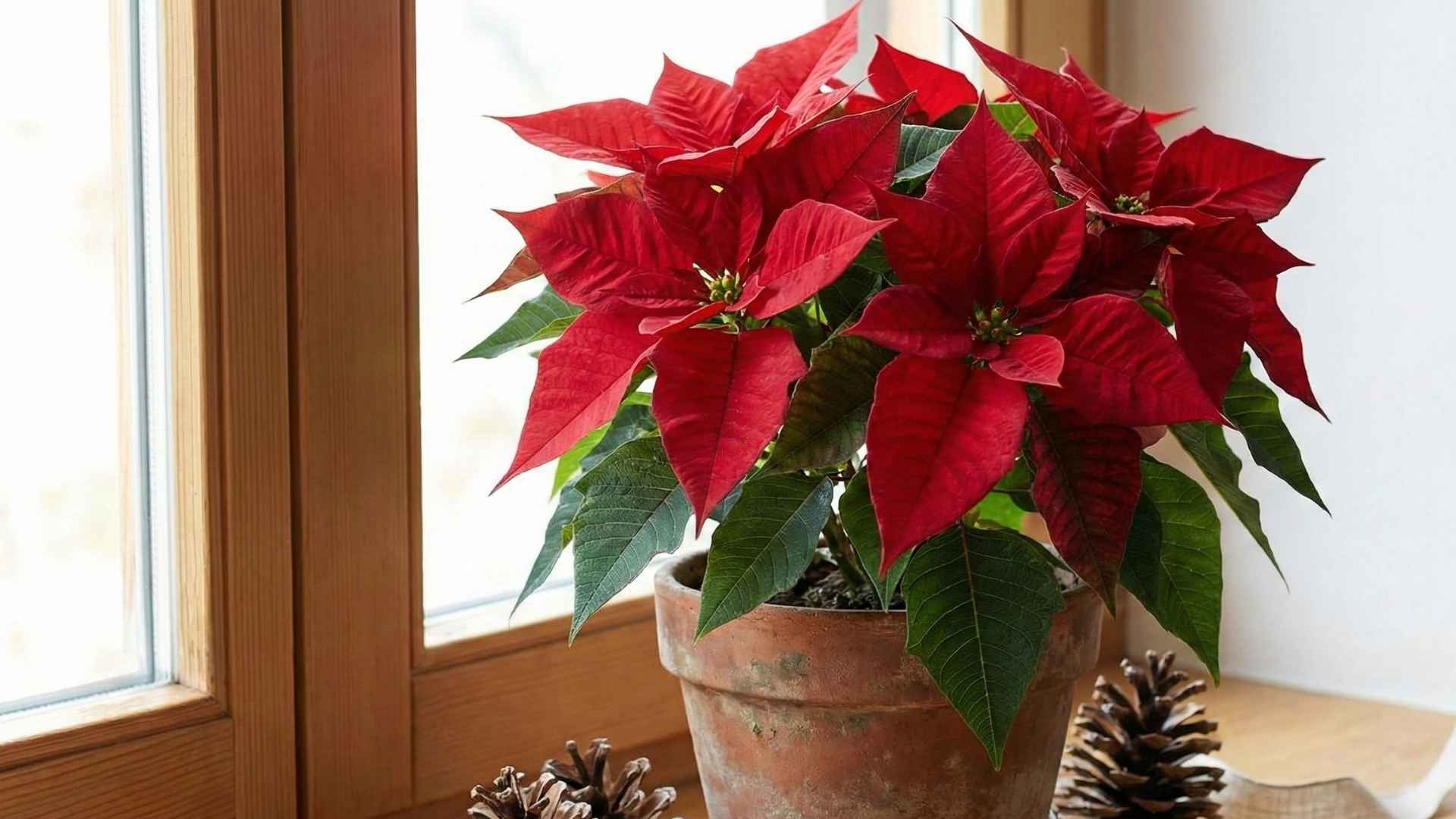
The Poinsettia (Euphorbia pulcherrima) is not a fragile flower. In its native habitat in the dry tropical forests of Mexico, specifically in the Taxco region, it grows into a woody tree reaching heights of up to 4 meters (13 feet). It survives droughts, intense sun, and rocky soil. So why does it die in your living room? The answer lies in the mismatch between its biological needs and our modern home environments.
This guide will bridge that gap. We will cover water chemistry, soil physics, photoperiodism, and pest management in a level of detail you won't find on generic gardening sites.
Part 1: The Botany of the "Christmas Star"
To truly master Poinsettia care, you must first understand what you are looking at. The large, colorful parts of the plant are not petals. They are bracts—modified leaves designed to guide pollinators to the true flowers.
If you look closely at the center of the bract clusters, you will see tiny, yellow, bead-like structures. These are the cyathia, the actual flowers of the plant.
Why does this matter?
The health of the bracts is directly tied to the energy reserves in the green leaves below. Unlike true flowers, which are designed to wither after pollination, bracts can persist for months if the plant remains in a vegetative state of low stress. When the plant gets stressed, it sheds leaves to conserve water for the stem. This is a survival mechanism evolved for dry seasons, but in your home, it looks like death.

Part 2: The Physics of Watering (It's Not Just About Quantity)
The advice "water when dry" is too vague for a plant this sensitive to root rot. We need to talk about soil oxygenation and osmosis.
The roots of the Poinsettia require high levels of oxygen. When you buy a plant from a store, it is usually packed in a peat-based substrate that retains water like a sponge. If you water this soil while it is still damp, the water fills every microscopic air pocket in the soil structure. Without oxygen, the roots cannot breathe (cellular respiration stops), and they begin to ferment and die. This is the perfect breeding ground for Pythium, a water mold that causes root rot.
The "Weight Lift" Technique
Forget strict schedules. The evaporation rate in your home changes daily based on central heating and sunlight.
- Calibration: Pick up the pot when you know it is bone dry. Memorize that weight.
- Daily Check: Lift the pot every morning. If it feels feather-light, it is time to water. If there is any heft to it, walk away.
Water Quality Matters
Poinsettias are sensitive to chemicals commonly found in municipal tap water:
- Chlorine/Chloramine: Can damage delicate root hairs.
- Fluoride: Causes necrosis (browning) on leaf tips and margins.
Recommendation: If possible, use rainwater, distilled water, or tap water that has been left to sit in an open container for 24 hours to allow chlorine to evaporate.
Part 3: The "Goldilocks" Environment
This plant is a diva when it comes to temperature. It craves stability.
The Draft Danger
Poinsettias are incredibly susceptible to thermal shock. A sudden blast of cold air from an opening front door or a drafty window frame can cause the plant to produce ethylene gas. This hormone signals the plant to drop its leaves (abscission) within 48 hours.
- Never place the plant near a radiator (too dry/hot).
- Never place it near an entry door (too drafty).
- Ideal Location: A bright living room corner, protected from direct drafts, with a stable temperature between 18°C and 22°C (65-72°F).
Part 4: The Year-Round Lifecycle (The Monthly Roadmap)
Most guides stop at January. We are playing the long game. Here is your roadmap to keeping the plant alive and making it bloom again next Christmas.
| Season | Phase | Detailed Action Plan |
|---|---|---|
| Winter (Jan-Mar) | Maintenance | Continue normal watering. Do not fertilize yet. The plant is resting. Leaves may drop naturally as the days get longer; this is normal. |
| Spring (Apr-May) | The Reset | By April, the bracts will fade or fall. This is time for surgery. Cut all stems back to about 10-15 cm (4-6 inches) above the soil. Leave 1-2 nodes (bumps on the stem) per branch. Repot into fresh, well-draining soil. |
| Summer (Jun-Aug) | Vegetative Growth | The plant will explode with green growth. Move it outdoors to a semi-shaded spot once night temps stay above 12°C. Fertilize every 2 weeks with a balanced NPK fertilizer (20-20-20) to support foliage. Pinch off the tips of new shoots to force branching. |
| Autumn (Sep-Nov) | Flower Induction | CRITICAL PHASE. Bring the plant inside. Check for bugs. Starting October 1st, initiate the dark treatment (explained below). |
The Science of Re-blooming (Photoperiodism)
Poinsettias are "short-day" plants. They measure the length of the night with a pigment called phytochrome. To trigger the color change from green to red, they need 14 hours of continuous, uninterrupted darkness every night for 8-10 weeks.
The Protocol: Every day at 5:00 PM, cover the plant with a light-proof box or move it to a pitch-black closet. At 8:00 AM the next morning, uncover it and give it bright light. Warning: Even a brief flash of light from a streetlamp or a car headlight during the dark period can reset the chemical clock and ruin the process.
Part 5: Comprehensive Troubleshooting
⚠️ Yellowing Leaves
Diagnosis: This is almost always a water issue.
1. If lower leaves turn yellow and drop: Root Rot (Overwatering). Smell the soil; if it smells swampy, you need to repot immediately and trim dead roots.
2. If leaves are crinkled and yellow patches appear: Magnesium deficiency. Use a fertilizer with micronutrients.
🍂 Sudden Leaf Drop
Diagnosis: Shock.
Did you move the plant? Did the temperature drop? Did you forget to water it for 2 weeks and then flooded it?
Solution: Stabilize the environment. Keep the soil evenly moist (not wet). It will regrow, but it takes patience.
Part 6: Extensive FAQ
1. Is Poinsettia poisonous to pets?
Despite the urban legends, the Poinsettia is not deadly. The milky sap (latex) is an irritant. If a dog or cat eats a large amount, they may experience stomach upset, drooling, or vomiting. It is far less dangerous than Easter Lilies or Sago Palms, which are lethal.
2. Can I use tap water?
Yes, but let it sit. The chlorine in fresh tap water can damage the sensitive root microbiome. Room temperature water is essential—cold water shocks the roots.
3. Why is my plant leggy and bare at the bottom?
This happens naturally as the plant ages, but it is accelerated by low light. The plant sheds lower leaves that aren't receiving enough sun to be efficient. To fix this, prune the plant back hard in the spring to encourage lower branching.
4. How big can they get?
In a pot indoors, they can easily reach 3-4 feet. In the wild in Mexico, they grow into trees up to 15 feet tall!
5. What are the white bugs on my plant?
These are likely Whiteflies. They love Poinsettias.
- Solution: Isolate the plant immediately. Use insecticidal soap or Neem oil spray every 3 days until they are gone. Check the undersides of leaves carefully.
6. Do I need to mist the leaves?
Misting is controversial. While Poinsettias love humidity, wet leaves can invite fungal diseases like Powdery Mildew. It is better to use a pebble tray with water underneath the pot (without the pot touching the water) to raise ambient humidity.
7. Why are the new leaves small and deformed?
This could be a sign of a Calcium or Molybdenum deficiency, which is common in peat-based soils over time. Repotting into fresh soil usually fixes this.
8. Can I change the color of my Poinsettia?
No. The color is determined by genetics. A red variety will always be red. However, breeders have created pink, white, marbled, and even purple varieties.
9. Why did my Poinsettia arrive dead?
If you bought it online or transported it in a cold car without wrapping it in paper, it likely froze. Even 5 minutes of exposure to freezing temps can kill the cells in the bracts.
10. When should I stop fertilizing?
Stop fertilizing in December when the plant is in full bloom. Restart in May when you see new green growth.
11. Is it safe for people with latex allergies?
Important: Poinsettias are part of the Euphorbiaceae family and produce a milky sap that contains latex proteins. If you have a severe latex allergy, avoid handling the plant or wear gloves when pruning.
12. How do I make the stems stronger?
Lack of airflow causes weak stems. In the summer, placing the plant outside where it experiences a gentle breeze will trigger the production of lignin, making the wood stronger.
13. Can I keep it in the bedroom?
Yes, as long as there is a window. Poinsettias (like all plants) respire at night (release CO2), but the amount is negligible and perfectly safe for sleeping.
14. Why are the flowers falling off?
The tiny yellow centers (cyathia) drop when the plant is past its prime or stressed. Once the yellow flowers are gone, the red bracts will eventually fade too.
15. Does it need special soil?
They prefer a slightly acidic soil (pH 5.8-6.2). A high-quality peat-based potting mix with plenty of perlite for drainage is ideal. Avoid heavy garden soil.
16. What causes grey mold on the leaves?
This is Botrytis. It happens when it's cool and damp, and air circulation is poor. Remove affected leaves immediately and improve airflow.
17. Can I prune it in winter?
No. Wait until the colorful bracts have faded (usually March or April). Pruning in winter removes the "flowers" you are trying to enjoy.
18. How much sun is too much?
In winter, they can take full direct sun. In summer, the hot midday sun can scorch the leaves, causing bleached patches. Partial shade is best for summer vacation outdoors.
19. Why does the sap irritate my skin?
The sap contains diterpene esters. Wash your hands immediately with soap and water if you get sap on them to avoid a contact dermatitis rash.
20. Is it worth keeping?
Financially? Maybe not, as they are cheap to buy. But horticulturally? Yes. Bringing a Poinsettia back to bloom is a badge of honor among gardeners. It proves you understand plant biology.
Conclusion
The Poinsettia is misunderstood. It is not a cheap plastic decoration, but a complex biological organism that reacts instantly to its environment. By following this guide, specifically the watering protocols and the light management, you elevate yourself from a "plant owner" to a gardener.
Your Poinsettia has the potential to be a lush, meter-high bush next Christmas. The only question is: are you disciplined enough to manage the darkness?
Discussion (0)
No comments yet. Be the first to start the conversation!
Leave a Reply